Boryna’s final sowing and death
The PeasantsMaciej Boryna’s final sowing and death turns a confused night-time awakening into a last act of labor on the fields of his ancestors. Barefoot and in his shirt, he mistakes the moonlit hours for morning, sets out to sow, and scatters handfuls of earth across the fields until he can no longer continue. The scene makes his death inseparable from the work and land that have shaped his life: his last labor is both futile in practical terms and, in the narration’s sacred imagery, a final offering of himself.
The Night Awakening
The episode begins in a village asleep outdoors and a quiet room where a cricket chirps in the fireplace. Jagusia’s breathing is the only other sound. As the first cockerels begin to crow, moonlight falls across Maciej Boryna’s face. He shifts, sits up, and tries to speak, but can manage only a gurgle in his throat. For a time he looks around vacantly, fumbling at the shimmering light as if he could gather the moonbeams in his fist.
His first words turn confusion into purpose: “Morning’s coming … it’s time …” He rises, looks out of the window, and takes the night for broad day, imagining that he has overslept and that urgent work is waiting. He crosses himself and begins to pray, yet the ordinary sequence of dressing breaks apart when he cannot find his shoes. His prayer dwindles into occasional words as he searches helplessly. The scene sets religious habit beside the habits of work: both remain in him, but neither can steady a mind that is losing its hold on the present.
Maciej opens the window, looks in the storeroom and the range, then goes outside barefoot and in his shirt. Lapa, asleep curled on the threshold, wakes at his steps, growls, recognizes his master, and follows. The dog’s recognition offers a small point of continuity amid Maciej’s disorientation; Maciej himself can no longer identify what urgent task he is meant to do. He scratches his ear and deliberates before deciding that it is time to sow.
The Field and the Recalled Hayrick
The journey through the farmyard brings him to the hayrick that had burned in winter and has since been rebuilt. At first Maciej intends to avoid it. Then he recoils, and for an instant the past breaks through: he pulls up a fence stake, holds it like a pitchfork, and rushes at the rick posts with a grim readiness to strike. Before he can hit anything, however, the stake falls from his hands. The brief return of force gives way to helplessness, and he continues toward the field rather than completing the attack.
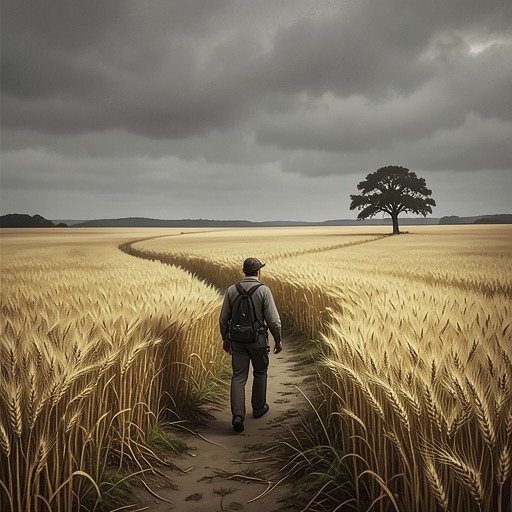
Beyond the hayrick, a long wedge of stubble runs from the road alongside the potatoes. The surrounding crops register the season’s growth: the rye bends beneath its ears, the wheat stands tall, and the young oats and barley show green through the mist and light. Against this abundant field, Maciej’s chosen work is impossible: he tries to sow soil into ground already carrying its crops. The contrast does not stop him. What persists is not a practical plan but the remembered necessity of sowing, returning in his mind with the force of a command.
The Last Sowing
Maciej kneels on a patch of ground and uses his shirt to gather earth, as if scooping grain from a prepared sack. When he has collected so much that he can barely lift it, he crosses himself, swings his arm, and begins to sow. He bends under the weight and advances slowly, scattering handfuls along the field in a broad, deliberate motion. Lapa dashes away from beneath his feet like a frightened bird, then returns to his master’s side.
The work continues past the field’s edges and obstacles. Maciej blesses each clod and stalk as he sows, stumbling over ridges, tripping into holes, and sometimes falling without seeming to feel it. When the earth in his hands runs out, he gathers more; when heaps of stones and prickly shrubs block the way, he turns back. At intervals he calls to Kuba as though directing the farmhand to draw the harrow gently. The imagined company of farm labor sustains the rhythm of the task even as its futility becomes plain to the reader.
As the night begins to fade and the stars grow pale, Maciej forgets to gather more soil and sows with an empty hand. The narration enlarges this failure into the scene’s central image: he seems to be sowing the remainder of himself, his lived days and human lifetime, onto the ancestral fields and returning them to God. The work has become an act of self-giving. Its repeated motion joins the bodily labor of the farmer to the language of blessing and prayer, without making the earth he scatters into actual seed.
Vision and Death
In the final hour, the light changes: the sky turns gray, the moon goes down, and the world seems to plunge into darkness and turmoil. Maciej perceives the grass, wheat, strips, furrows, clods, trees, thistles, and stones as moving against him. The field that had received his labor now appears to surround and obstruct him; he wants to cry out and flee but cannot make a sound or find the strength. Voices call, “Stay with us! Stay with us!” The land’s earlier quiet abundance has become an overwhelming presence at the threshold of death.
Then everything falls silent. In a flash of lightning, Maciej sees God the Father seated on a throne of sheaves, stretching out his arms and inviting the weary farmhand to come. Maciej spreads his hands as during the Elevation and answers, “Thanks be to God!” He falls face down before the Most Holy Majesty and dies in what the narration calls the hour of the Lord’s favor. Dawn rises above him, while Lapa howls at length and mournfully.
The scene’s ending gives religious form to the work that has occupied Maciej’s final hours, but it does not erase the distinction between sowing and its outcome: his labor remains barren in the field, even as the vision imagines a welcome beyond it. The final handfuls of earth, the empty hand, the throne of sheaves, and the dog’s lament bring the episode from farm routine to death without separating the two. Maciej’s life ends in the gesture of a farmer sowing, with the land of his ancestors as both the ground of his last labor and the image through which the narrative renders his departure.